ARTICLE
10 Australian trends to watch in the next 10 years

Over the next decade, Australia will hit demographic milestones that highlight how rapidly the nation, states, territories, and cities are changing. Social shifts are occurring as Australians live longer, have children later and work longer. From demographic shifts to infrastructural innovations, the trajectory of the 2030s promises to be anything but mundane. Let’s delve into the changing landscape of our nation and explore the pivotal milestones projected to shape Australian life over the coming years.
Here’s 10 trends to prepare for over the next 10 years in Australia.
2025
Generation Beta begin being born, marking the first time seven generations have been alive at once.
2026
Western Sydney’s international airport will open[1], marking the birth of the aerotropolis.
2027
Gen Z will enter the parenting life stage (as 2027 marks the year that the oldest Gen Zs reach 31, which is the median age of mothers at first birth[2]).
2028
The oldest Generation Alphas will vote in their first federal election.
2029
New South Wales will reach a population of nine million while Sydney will approach six million[3].
2030
Australia will reach a population of 30 million people[4], and South Australia will reach two million[5]. The oldest Gen Betas will start primary school.
2031
Melbourne is predicted to overtake Sydney as the largest city in Australia.[6]
2032
The Summer Olympics will be held in South East QLD, experienced by more than six million QLD residents.
2033
The oldest Generation X workers will reach the retirement age of 67.
2034
New South Wales will reach a population of 10 million[7], and Victoria will hit 8.5 million.
2035
Australia will reach a population of 32 million people and life expectancy will reach 87 for females and 83 for males.[8]
A decade of population and generational change
The next decade will be characterised by population growth, with Australia predicted to reach a population of 30 million by 2030 and 32 million by 2035.
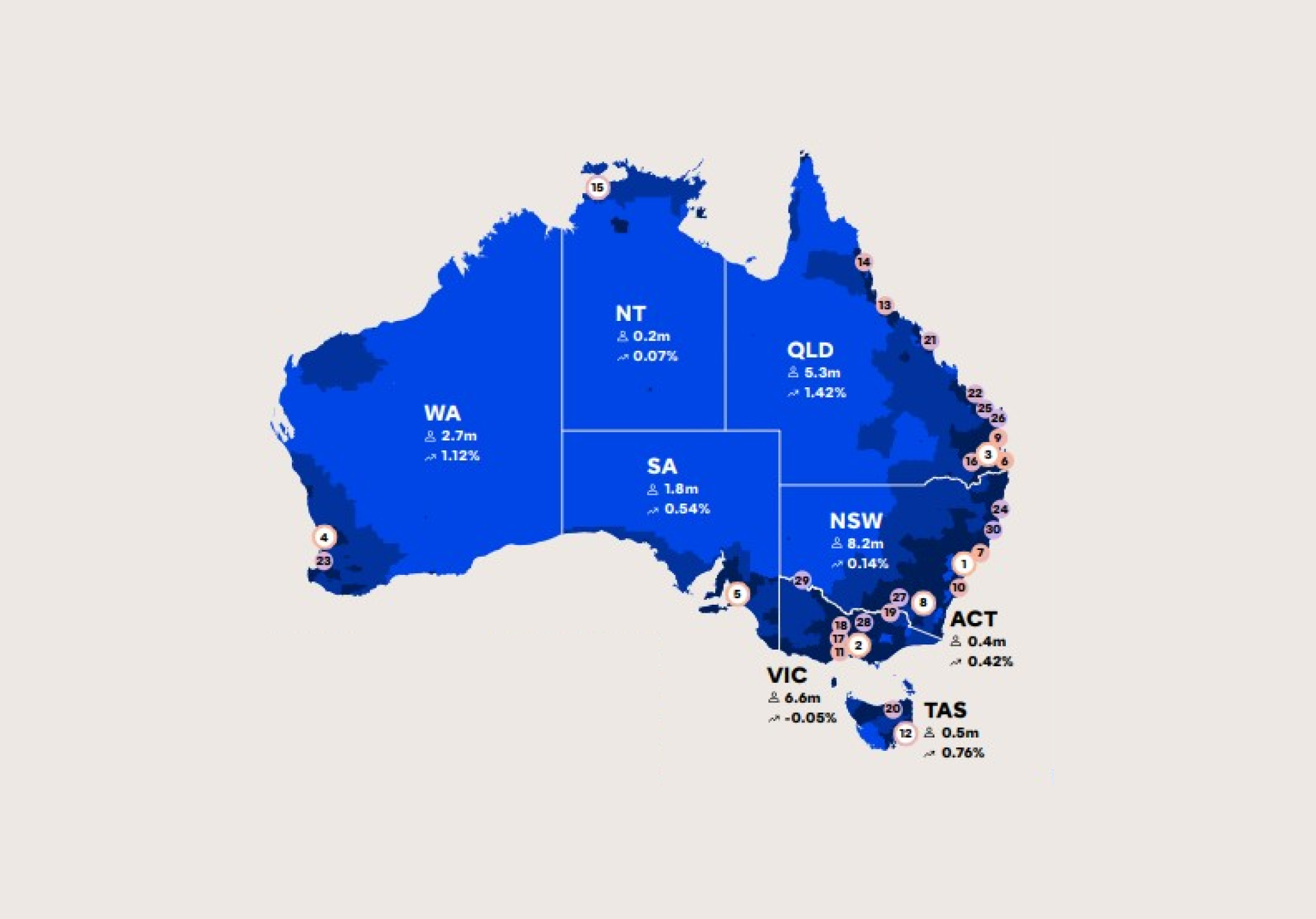
There are major milestones ahead for many states, with New South Wales expected to reach 10 million residents, Victoria reaching eight million, Queensland reaching six million, Western Australia reaching three million and South Australia reaching two million residents. In the decade ahead Melbourne will also overtake Sydney as Australia’s largest city.
With each generational milestone, societal norms adapt accordingly. In 2027, as Generation Z enters parenthood, the landscape of Australian families will evolve, marking the normalization of Gen Z parents in communities. Similarly, 2028 marks a pivotal year as the eldest Gen Alpha members participate in their inaugural federal election, a testament to the rapid passage of generational cycles.
Generational landmark moments will also occur as Gen Beta start school, Gen Alpha vote for the first time, Gen Z become parents and Gen X enter their retirement years.
Population Growth
By 2030, Australia’s population is projected to reach 30 million, aligning symbolically with the year itself, while New South Wales approaches 9 million. This growth presents both promising opportunities and challenges. A burgeoning Australian populace brings economic prospects, yet requires planning to mitigate the complexities of housing shortages, transport congestion, and infrastructural strain.
Investments in technology and forward-thinking urban planning will be important to uphold Australia’s reputation as an innovative global leader. Transitioning towards smarter cities and efficient resource management will be crucial as we accommodate this growth, ensuring a harmonious balance between economic prosperity and societal well-being.
Major Events and National Identity
Significant events like the 2032 Brisbane Olympics and Melbourne’s ascendancy over Sydney as the nation’s largest city in 2031 encapsulate the shifting cultural and social dynamics within Australia. These milestones offer not just international recognition but also provide arenas for celebrating human perseverance, achievement, and unity.
Yet, while such grand occasions foster a sense of national pride and cohesion, they also reflect the importance of cultivating resilient communities. As cities grow and diversify, the intricacies of multicultural communities become paramount, underscoring a collective effort towards fostering inclusive communities that embrace cultural intelligence and diversity.
Fostering a Visionary Future
As we gaze towards the 2030s, several core principles will define Australia’s success on a global scale: building strong communities, cultivating a robust economy, ensuring safety, and nurturing a culture of innovation. By embracing these tenets, Australia is poised to remain an aspirational destination characterized by quality living and vibrant multicultural integration.
The way forward demands not only strategic foresight but also active participation from communities and leadership alike. Cultivating a mindset open to change, whilst addressing existing challenges with creativity and resilience, will pave the way for a thriving, future-ready Australia. As we embrace these transformations, the journey ahead promises to be exhilarating for all Australians, reinforcing our beloved nation’s standing on the world stage.
To address these changes, leaders will do well to adopt the mindset of a futurist; that is, someone who can anticipate change, embrace disruption and find opportunities for growth.
Like a surfer, leaders position themselves for the next wave of change. They have their eyes fixed on the horizon, scanning for the next opportunity amidst disruption.
See our population map and generational profile infographic for the current state of the nation.
[1] https://wsiairport.com.au/
[2] https://www.abs.gov.au/statistics/people/population/births-australia/2023
[3] https://www.abs.gov.au/statistics/people/population/national-state-and-territory-population/latest-release
[4] Using the high series of ABS population projections https://www.abs.gov.au/statistics/people/population/population-projections-australia/2022-base-2071
[5] https://www.abs.gov.au/statistics/people/population/population-projections-australia/2022-base-2071
[6] https://www.abs.gov.au/statistics/people/population/population-projections-australia/2022-base-2071
[7] https://www.abs.gov.au/statistics/people/population/population-projections-australia/2022-base-2071 – using the largest population
[8] https://www.abs.gov.au/statistics/people/population/population-projections-australia/2022-base-2071 – using medium assumption.