ARTICLE
Shaping a human-centered AI future

In the 1980s, when mobile phones first launched there was a common reaction.
People looked at the brick-sized devices and said ‘Why would I ever want or need to talk to someone while walking down the street?’ In the 1980s being reachable everywhere by phone felt ridiculous and intrusive.
And well, here we are today.
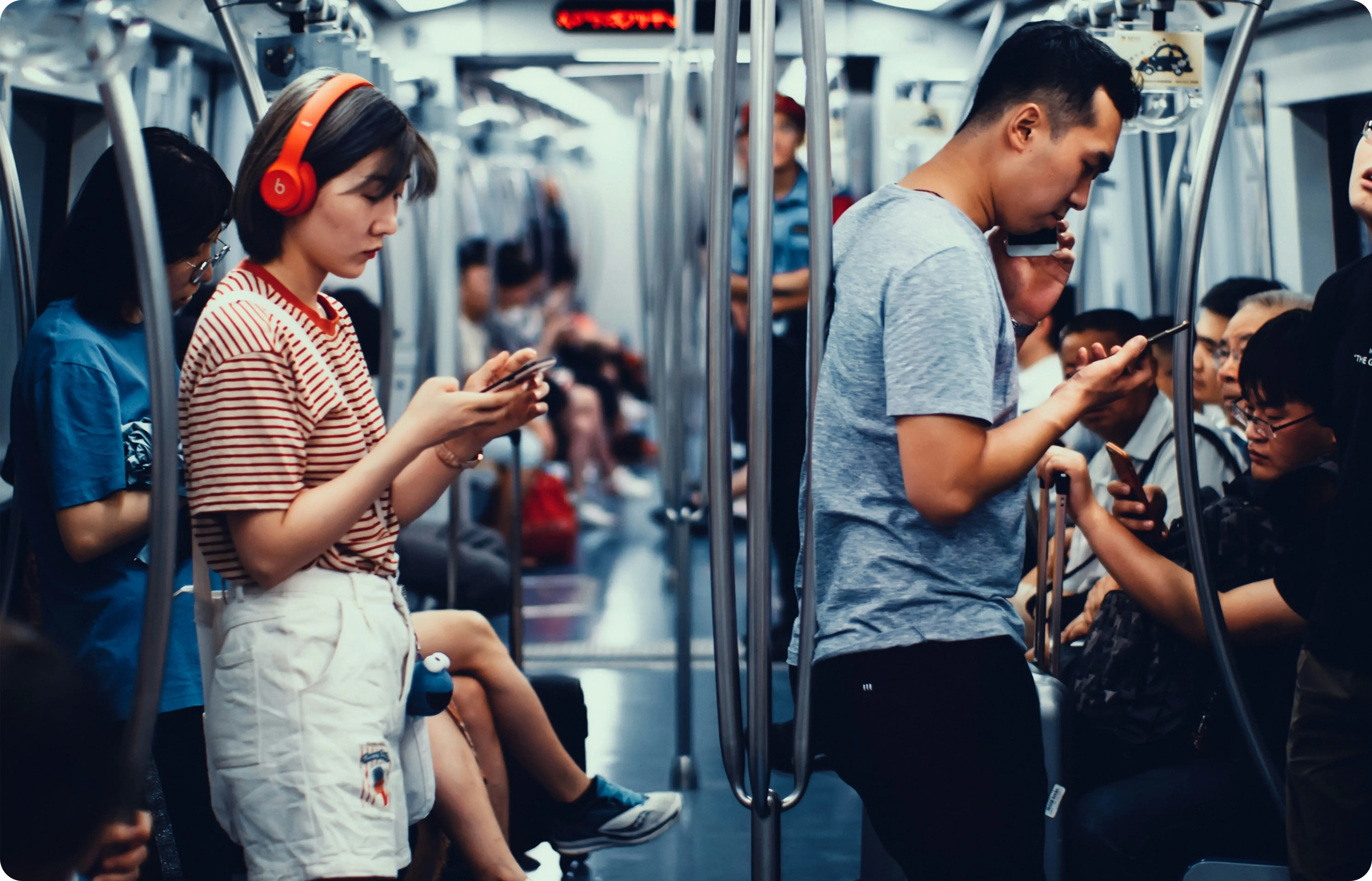
Not only are we talking while walking down the street, we’re running businesses, ordering groceries, navigating foreign cities, and more.
Looking back, we laugh. But as is said history repeats itself. Every single time new technology emerges, humans experience two very natural reactions, a mixture of intrigue and optimism, as well as hesitation and scepticism. And now, here we are again at the precipice with Artificial Intelligence.
AI promises many things, and with the rapid rate of progress it’s being weaved into our lives. In this article, we draw on insights from our report Shaping a human-centred AI future to explore sentiment towards AI, the use of AI and the future of work.
The duality of AI
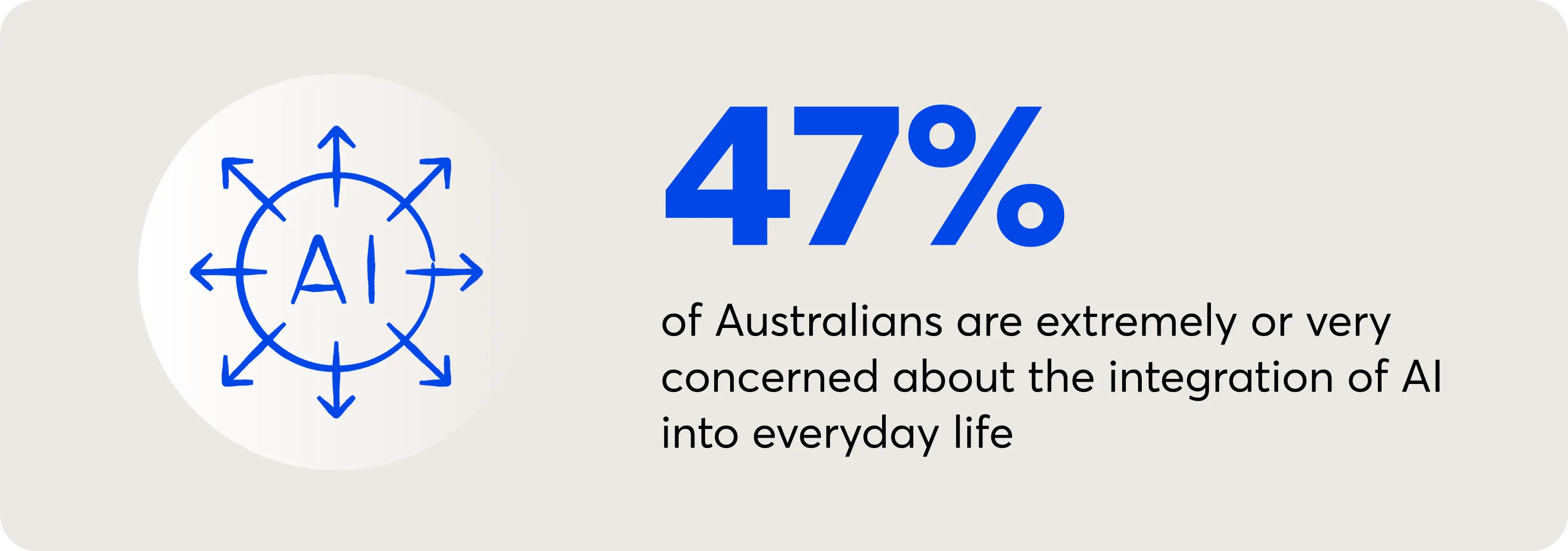
While many are excited about the arrival and use of AI, 47% of Australians are extremely or very concerned about the integration of AI into everyday life. This hesitation may stem from AI’s ‘black box’ nature. People input a request on one side, but because the inner workings remain hidden out of sight, it naturally creates a sense of uncertainty.
70% of Australians see AI as a threat more than a tool. This high level of caution suggests that most people do not yet see AI as a helpful partner. Instead, they view it as a potential threat to their safety, jobs, or privacy. This increases for the older generation with 80% of Baby Boomers saying they see AI as more of a threat than a tool, compared to just 65% of Gen Z.
Despite the concern, people are making AI part of their everyday life
When asked how often do you use AI in your personal life three in five Australians are using AI such as ChatGPT, Claude or Gemini in their personal life at least monthly (63%), with just over half using it weekly (54%).
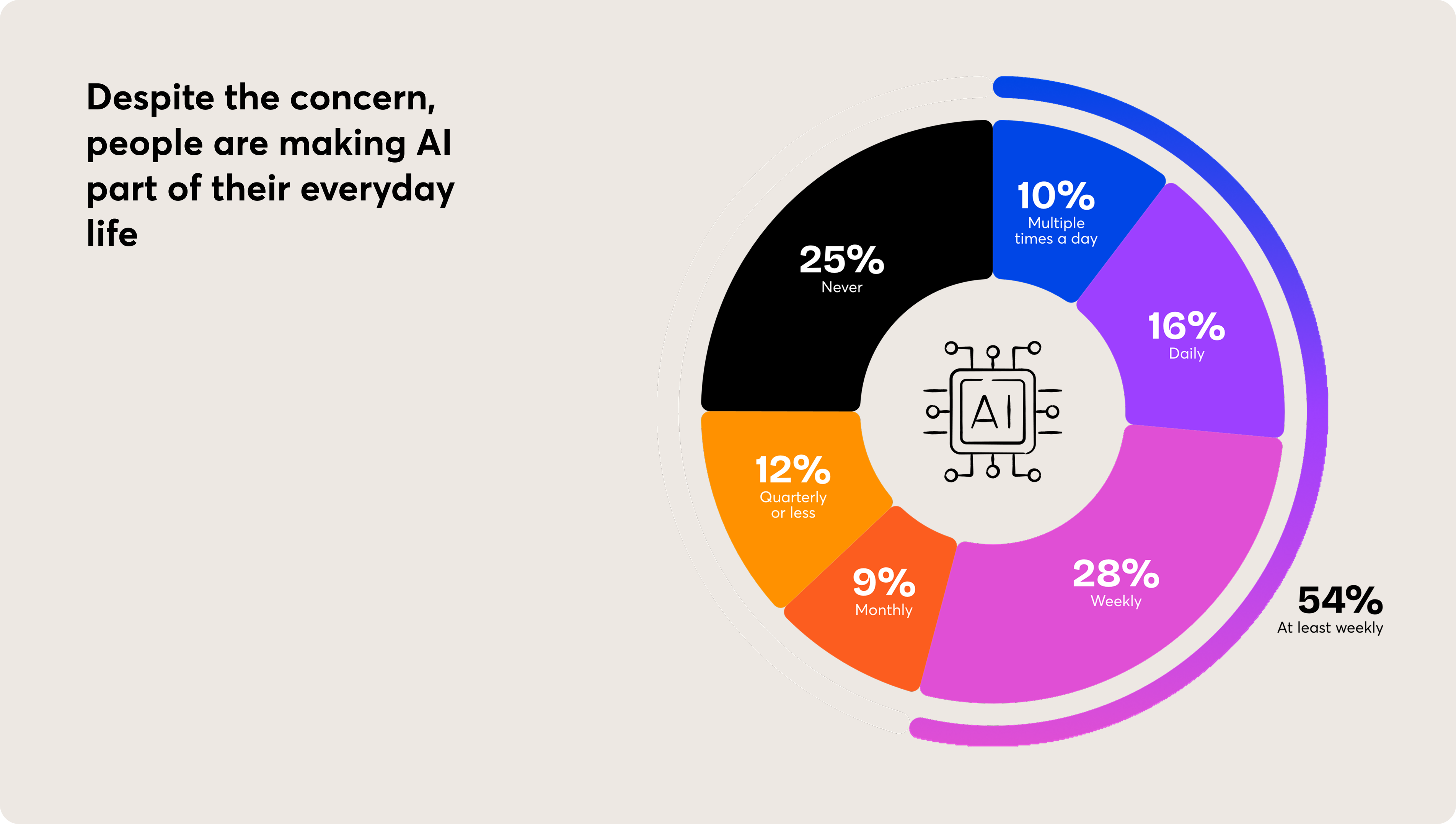
Younger generations are more likely than their older counterparts to embrace the tool, with two thirds of Gen Z (66%) and Gen Y (65%) using it at least weekly. Although there is a high uptake of users, a quarter of Australians never use it in their personal life. This increases to almost half for Baby Boomers (48% never use AI in their personal life).
Activities trusted with AI usage
With AI transforming the gathering of information, it is important to understand where consumers trust lies in its recommendations and advice. Particularly if more people were to turn to AI rather than engaging a traditional service, the impact on businesses could be significant. At this stage AI is trusted for activities that can be perceived as lower risk. Three in five Australians turn to AI for travel advice (61%) or personal recommendations (58%).
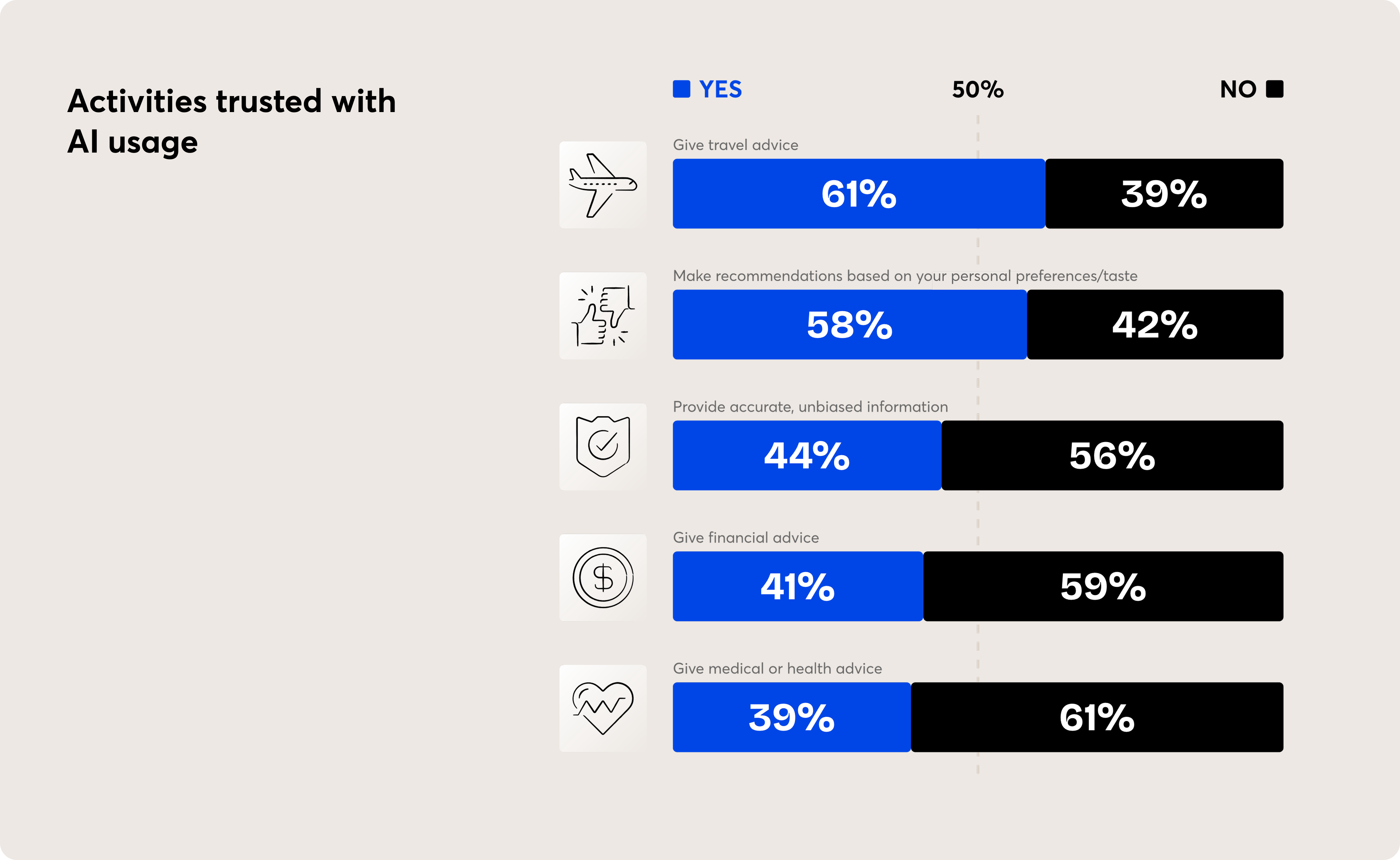
Just over two in five Australians (44%) trust AI to provide accurate unbiased information. With trust still to grow in the accuracy of information provided by AI, it is unsurprising that Australians are less likely to trust AI to give financial (41%) or health advice (39%). As time goes on and trust grows, however, Australians may look to AI to provide support in a cost-effective streamlined way.
Organisations need to take advantage of new technology to stay relevant, however, there is an equal need to keep investing in the next generation of workers. Without this investment, a major gap in expertise will likely emerge in the next decade when experienced staff are needed. In fact, 46% of Australians are extremely or very concerned that relying on AI for basic tasks hinders the development of future leaders.
The greatest word of caution is to embrace the tool while rejecting cognitive surrender. The ease of using AI should not lead to atrophy of the mind. Instead, it is essential to maintain critical thinking and the unique traits that define humanity.
The ideal future is one where humanity is kept at the centre. Ultimately the success of AI integration will not be measured by the level of automation, but by how well human ingenuity is protected by the technology that was built to serve it.