ARTICLE
The importance of belonging in cultivating school communities

In an era where trust in many traditional institutions is declining, schools frequently remain a trusted pillar within their local communities. However, maintaining and building upon this position requires a strategic approach to parental engagement.
As people broadly move away from passive reliance on institutional brands, they increasingly seek direct, human connection. This shift underscores the importance of belonging as a central metric for a thriving school environment.
How belonging drives enrolment stability
When schools successfully build trust through authentic engagement, it translates into a measurable sense of belonging that directly impacts enrolment stability and community advocacy. While many schools measure parent satisfaction, satisfaction alone can function as a lagging indicator, whereas belonging serves as a reliable lead indicator for retention.
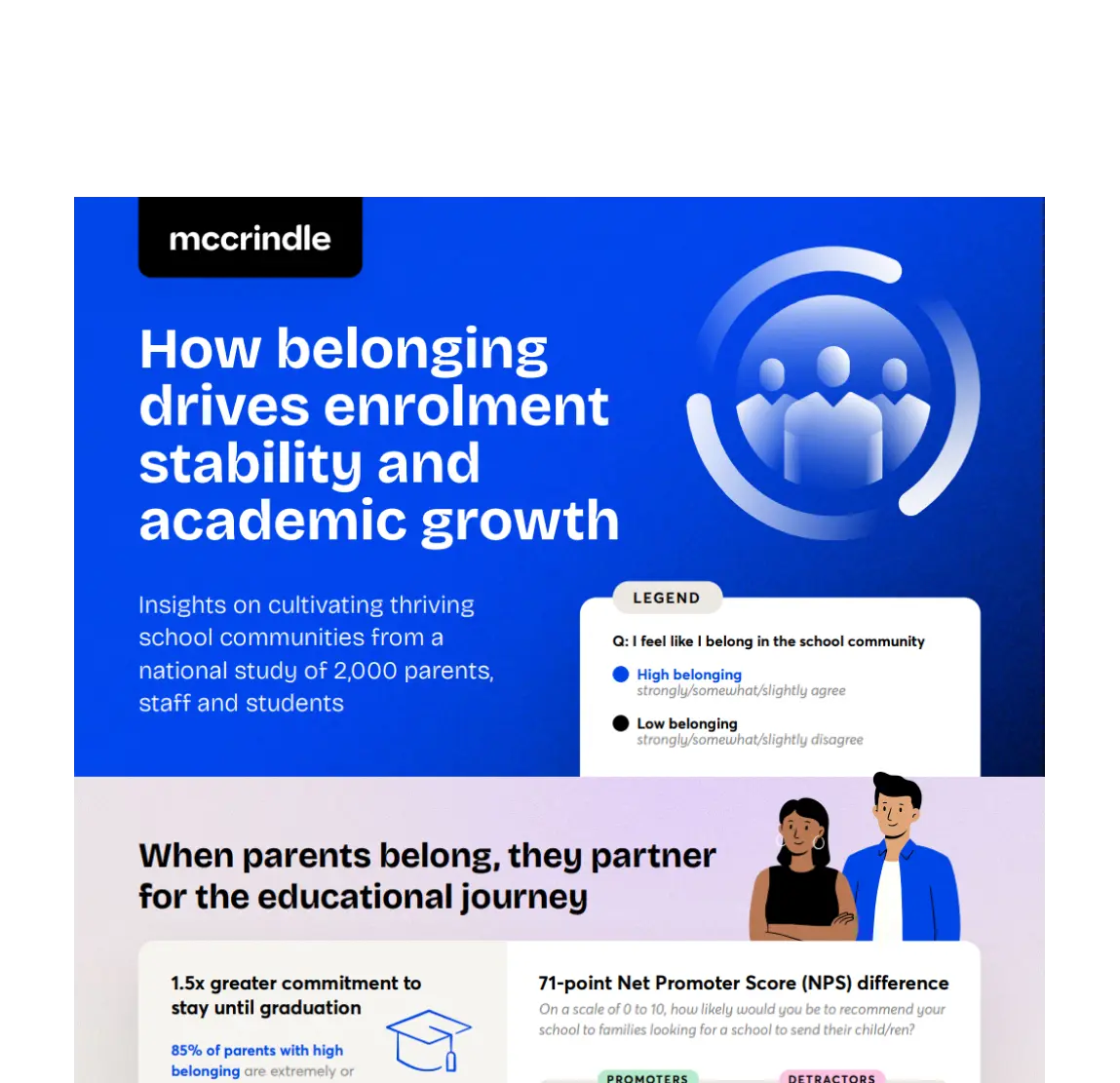
When parents experience high belonging, they demonstrate a 1.5 times greater commitment to remaining at their current school until graduation. Data shows that 85% of parents with high belonging report being committed to staying, compared to 56% of those with low belonging. This connection also strongly influences a school’s Net Promoter Score (NPS). Parents with high belonging generate an NPS of +33, while those with low belonging record a score of -38. This 71-point differential demonstrates how belonging converts basic satisfaction into organic community advocacy and long-term stability.
The impact of belonging on student outcomes
The benefits of a highly engaged community extend beyond parent retention to directly influence the classroom environment. When a school cultivates a culture of belonging, it sets students up for success both during and after their schooling years.
Data indicates that students who report a high sense of belonging are 2.2 times more likely to feel inspired to learn, with 59% agreeing with this statement compared to just 27% of students with low belonging. Furthermore, belonging correlates strongly with a student’s broader outlook. Students with high belonging are 2.1 times more likely to feel hopeful about their future (66%) than those experiencing low belonging (32%).
The foundation of trust and authentic leadership
The transition towards relational engagement highlights what can be termed a personality premium, where the authentic and relatable elements of a school and its leadership form the basis of community trust. Before a sense of belonging can be established, schools must demonstrate a baseline of integrity. Research indicates that parents identify authenticity (60%), consistency (58%), and transparency (55%) as the essential characteristics they look for in a community relationship.
When these foundational elements are met, school leaders can move beyond primarily administrative roles to become visible, human leaders. For 56% of Australians, trusting an organisation’s leader is highly important to their decision to engage. This expectation is more pronounced among younger demographics, with Gen Z parents being 1.8 times more likely than older generations to value knowing the story and values of a leader. By humanising communications, ensuring visible leadership at the school gates, and empowering staff to share their expertise, schools build the foundational trust required to foster genuine belonging.
Meauring connection to build thriving schools
As the saying goes, you can’t manage what you don’t measure. But how do you measure belonging? McCrindle’s Thriving Schools Index is a school stakeholder survey that measures 6 domains across students, parents, and staff through a streamlined 10-minute survey.
By benchmarking these insights, school leaders gain a clear view of their community’s health, allowing them to develop evidence-based strategies that build authentic trust, foster belonging, and support the long-term success of their school.