ARTICLE
How AI is impacting the career landscape

AI has moved from the realm of science fiction into the everyday of Australian life. What was an emerging technology just a few years ago is now embedded in how we search, write, plan, shop and work. Yet while much of the public conversation focuses on what AI can do, our new research highlights how people feel about it.
The findings reveal duality. More than half of Australians (54%) are now using AI in their personal lives at least weekly, with one in ten (10%) using it multiple times a day, 16% daily and 28% weekly. People are finding value in these tools. At the same time, many hold reservations about the impact of AI particularly when it comes to their careers.
In this article, we unpack what the data tells us about how AI is reshaping the career landscape, and what workers, parents and leaders can do in response.
A threat more than a tool
For all the excitement surrounding AI, Australians are approaching it with more caution than optimism. When presented with the statement “I see AI as a threat more than a tool for society”, almost seven in ten Australians (70%) agreed, with one in four strongly agreeing.
It tells us that the dominant public sentiment towards AI is not enthusiasm but apprehension. While there are plenty of voices painting a picture of what AI makes possible technologically, the reaction to AI tell a more complex story. Australians are using AI in many different ways, yet they remain sceptical of it.
The quiet fear in the workplace
One in four Australians (23%) are extremely or very concerned that they will lose their job in the next 12 months due to AI. For workplace leaders, this deserves attention. In a team of 20 people, around five may be carrying the fear that their role could disappear within the year. That concern may never be voiced but it is present. This creates an interesting tension. Organisations are pursuing every possible productivity gain, and AI promises to accelerate work and improve margins.
Yet the human side of that equation, how workers feel about the technology being introduced around them, is often overlooked. The data suggests that the success of AI in the workplace will depend as much on managing sentiment as on deploying software.
A generational lens on AI
While scepticism is present across every generation, it is most pronounced among older Australians. 65% of Gen Z see AI as more of a threat than a tool, rising to four in five (80%) Baby Boomers.
Yet younger Australians face a unique kind of exposure. They may be more confident with technology and quicker to adapt, but their life stage leaves them more exposed from a jobs perspective. Gen Z are choosing their courses of study, entering the workforce and working out what career is right for them, all at the very moment AI is reshaping entry-level roles.
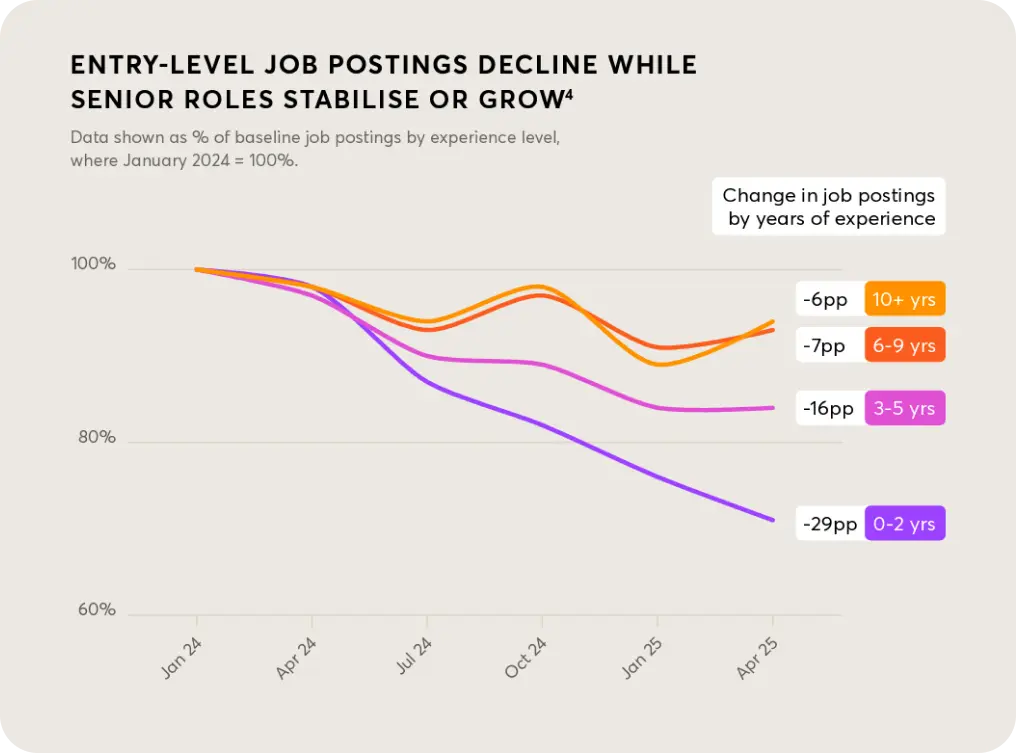
For this generation, AI represents both great opportunity and great challenge. They are moving into a knowledge economy equipped with AI tools, but they are also making decisions about their future with far less certainty than previous generations. Some are already changing courses or career direction in an effort to future-proof themselves against disruption at the very start of their working lives.
Looking further ahead, Generation Alpha will be the first generation to have AI at their fingertips throughout their secondary schooling. How they learn to use it, and how parents and educators guide them, will shape the workforce of the 2030s.
How Australian workers are responding
Concern about AI is not leading to paralysis. Instead, many Australians are taking practical steps to prepare. When asked what they had done in the past six months in response to concerns about AI-driven job losses, workers pointed to two leading actions.
Staying up to date with AI in their industry. The most common response was keeping informed about how AI is being used in their field. This is re-skilling and retooling happening in real time, and it reflects what leaders at the cutting edge are already doing: paying close attention to how their industry is evolving, regardless of age or seniority.
Researching more AI-resistant careers. The second most common response was researching careers or industries seen as less vulnerable to AI disruption. This ties directly back to the sense of threat. Workers in industries already experiencing disruption are considering where they might find greater security in the years ahead.
Together, these responses show a workforce that is anxious but adaptive. Australians are not simply waiting to see what happens. They are learning, planning and, in some cases, preparing to pivot. For employers, this represents both a risk and an opportunity: the risk of losing talent to perceived safer industries, and the opportunity to harness a workforce that is actively seeking to build new capabilities.
What this means for leaders
- Understand the sentiment. If 70% of your workforce see AI as more of a threat than a tool, declaring your organisation “AI first” or rolling out AI everywhere without context is likely to heighten anxiety rather than build buy-in.
- Reframe AI from cost-out to value-add. When employees hear leaders talk about AI, they often hear cost reduction. Historically, that has meant fewer staff and the removal of simpler tasks, so it is little wonder people feel their jobs are under threat. The better approach is to position AI as a value-adding tool that expands the pie rather than simply reducing costs. When AI is framed around innovation, growth and doing things that you previously couldn’t, teams are far more likely to get on board.
- Lead with foresight. Leaders look further down the road than their teams. Being aware of the trends, the sentiment and the lay of the land allows leaders to guide their people with confidence through a period of significant change.
- Lead with coherent values. Perhaps most importantly, leaders need clarity on the purpose of AI within their organisation. When leaders are clear that AI is a tool to support people, not replace them, and that the organisation holds a strong commitment to putting people first, it gives teams the confidence to embrace change.
The message for teams can be simple: we are building something here that is supported by AI, but not ruled by it. That framing builds morale, strengthens culture and unlocks the collaborative, agile innovation that genuinely drives productivity.
To explore the full findings, access Shaping a human-centred AI future in McCrindle Plus.